
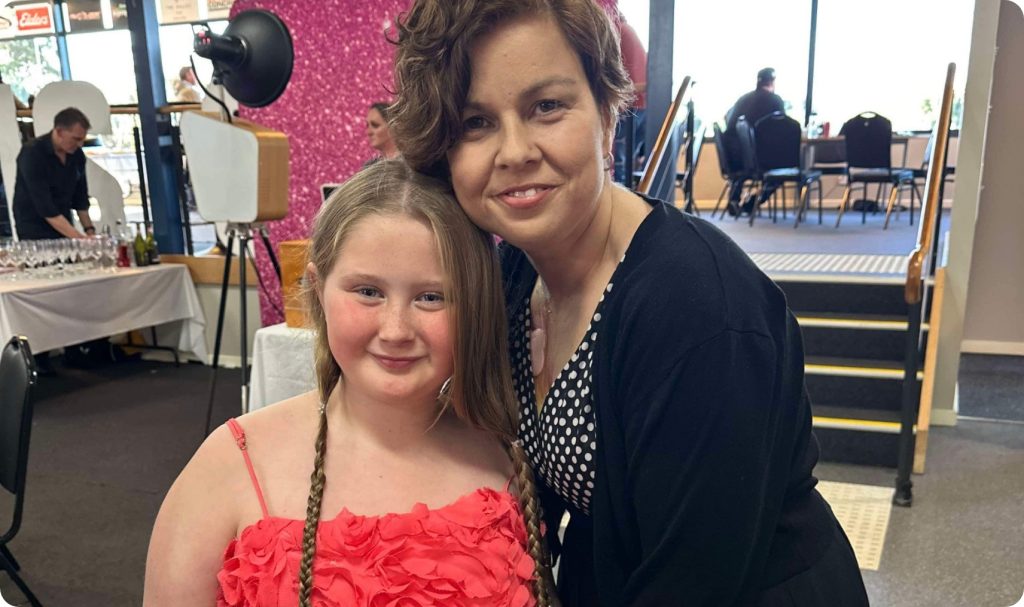
In early 2023, I was diagnosed with stage 2, grade 3 triple-negative breast cancer (TNBC). It was a moment that changed my life. Initially, my concerns were brushed aside because of my dense breast tissue—something many young women face. But I knew something wasn’t right, so I pushed for answers. My persistence led to an early diagnosis, and that’s why I tell every woman: Advocate for your own health. You know your body better than anyone, and if something feels off, follow your gut.
After 14 months of fighting with curative treatment, the cancer metastasized to my lungs in July 2024. The news hit hard. But here’s the thing—cancer is just a part of my story. It does not define who I am.
I am so much more. I’m a mother, social worker, wife, step-mum, dog-mum, empath, joy-bringer, and relationship-builder. I bring joy and love, even when things are tough. I live fully, even as cancer knocks on the door of death. But I’m not answering that knock yet—not today.
I want young women to hear this: Be breast aware. Especially if you’re told you have dense breast tissue. Don’t wait until the age of 40 for routine screenings. Know your body. Get familiar with your breasts. Demand an ultrasound, especially if something feels wrong. While I understand that free screening isn’t available until age 40 and that this creates a financial barrier for some, it is crucial to push for an ultrasound, not just a mammogram! It’s not just about being aware that breast cancer exists—it’s about being proactive and knowing what to do. It’s your health. You’re worth that fight. It’s not just about knowing breast cancer exists—it’s about knowing what to do about it and pushing for the right screenings and tests.
Too many people think breast cancer is no longer deadly, and I want to change that perception. There is still no cure for metastatic breast cancer. My dream is a world where women with early-stage breast cancer have access to genomic sequencing so they can get treatments that are tailored specifically to them. I’d love to see a cure, of course, but until then, my hope is that breast cancer can be treated like a chronic illness—a manageable condition, not a life sentence.
Now, what does it mean to live with metastatic or Stage IV TNBC (mTNBC)?
It’s complicated.
Yes, I experience fear, grief, and frustration. Some days are darker than others. But I also feel more alive, more present, and more connected than ever before. It’s strange to say, but despite everything, I’ve never been happier.
What does living look like for me?
It means being fully present with the people I love. I enjoy every conversation, and when I’m with you, I’m with you—no distractions, no phone, just pure connection. I listen deeply and give people my full attention, and in those moments, I genuinely light up. I take in people’s names, learn their stories, and express my gratitude for every interaction. Unless you’re rude—then, sorry, I have no time for that! But I’m also quicker to forgive, both others and myself. Life’s too short to hold grudges.
I don’t save things for ‘special occasions’ anymore. The nice wine? I drink it now. The expensive perfume? I wear it just because. Candles? They’re for today, not to sit on the shelf forever.
It even means tackling the practical stuff—sorting out superannuation, wills, and financial advice. It’s freeing to get it done, to face the realities head-on, so I can focus on what really matters: living.
Living to me means laughter, joy, and taking silly photos. I’m all about creating memories, whether it’s in the hospital, in traffic, at the theatre, or just at the supermarket. I go on random car rides with my family, visit country pubs, and soak in every bit of quality time with them. I refuse to sweat the small stuff. The dishes will still be there tomorrow, but moments with my kids—like impromptu dance parties in the kitchen—those are what count.
I’ve learned to slow down and appreciate the simple things, like sunsets, the smell of daphne flowers and roses, or a beautiful door handle in the middle of a busy Melbourne street. Life is about sitting on the oncology room floor, playing with a child and hearing her story as she waits for her dad. It’s about eating good food with good friends and really enjoying the moment, without worrying about the future.
I’ve also discovered self-love and self-compassion—something that doesn’t come easily. Don’t get me wrong: this has taken journaling, therapy, and a lot of inner work. But it’s real. And ironically, I’ve never loved my body more, even though it’s riddled with cancer. I walk into a room now, and people notice—maybe because of the GoFundMe page, maybe because of my story. I don’t mind. I’ll happily chat with them because I’ve let go of worrying about what others think. It’s incredibly freeing.
Through all of this, I’ve seen the true spirit of the people around me. I’ve been humbled by the help I’ve received, and amazed by the friends who’ve shown up, even on my darkest days. I overshare on social media because, in a way, it helps me connect with even more people.
I’ve never loved harder, never felt more happiness, and never been more deeply connected to those around me.
Of course, it’s bittersweet—knowing what’s coming, knowing how this story likely ends. But for now, I’m here. I’m watching relationships grow, watching my loved ones find strength in one another. It’s beautiful, even though I know how I got here.
We were watching The Rookie the other night, and there was a quote that stuck with me: “Some people who are dying are still arseholes; they aren’t all saints.” It’s funny, but it’s true! But for me, I think I’ve embraced the beauty of this surreal grey area where I now live. Time feels weird, fluid, and sometimes irrelevant.
The hospice social worker once said to me, “Some people really come into their soul when they are dying,” and I feel that deeply. I’m far from perfect, but I am embracing this strange space I’m in, learning to live fully in the now.
So, my question—my life lesson—to you is: If I’m showing you how to use the gift of time, how will you show up and live your life?