
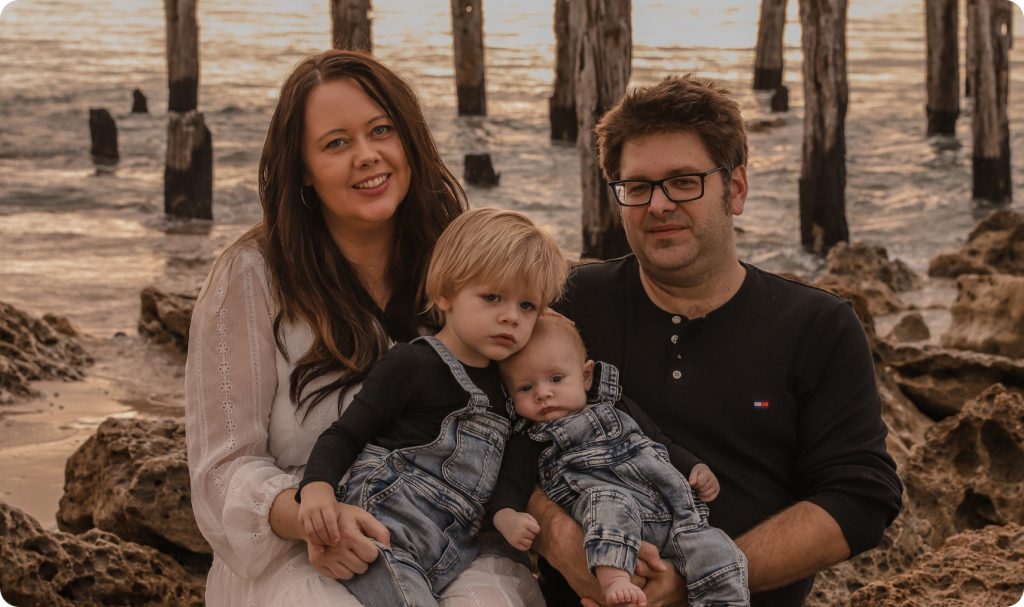
Linda’s journey is one of both immense love, deep heartache and persistent hope.
In September 2021, while 30 weeks pregnant with her second son, Eli, Linda discovered a small lump in her right breast. Initially dismissed as a blocked milk duct caused by pregnancy, the lump persisted throughout the rest of her pregnancy. After Eli was born in November, Linda continued to raise concerns about the lump with every healthcare professional she encountered. During her baby’s routine six-week check-up in January 2022, she once again expressed her worries to her GP. This time, her proactive doctor listened carefully and promptly referred her for further testing. A biopsy soon confirmed Linda’s worst fear: she had HER2-positive breast cancer.
Linda began chemotherapy right away, but subsequent scans revealed even more alarming news—additional spots were biopsied and came back as triple-negative breast cancer (TNBC). Following a double mastectomy and gruelling treatment, she was declared cancer-free in September 2022. It seemed like a hard-fought victory at the time, and Linda returned to work to rebuild her ‘new normal.’
But in May 2024, Linda’s world came crashing down again.
Her breast expander, awaiting reconstruction, pierced through her skin, requiring emergency surgery. During that surgery, her surgeon found a flat mass on her chest wall, which was confirmed as an aggressive form of TNBC. Further testing revealed the cancer had metastasised to her lungs, brain, adrenal glands, neck, and ovary. Linda was now facing metastatic triple negative breast cancer (mTNBC)—an incurable, terminal diagnosis at just 38 years old.
The diagnosis was devastating. Linda recalls, “I thought when my auxiliary biopsy came back clear that I was going to be okay. But when the scans showed it had already spread, I couldn’t comprehend it. I was facing my mortality before I had even turned 40, with my kids only 2 and 5. I couldn’t help but think they would hardly remember me.”
Linda’s life shifted dramatically as she began treatments focused on prolonging life rather than curing the disease. She started a new chemotherapy regimen alongside brain radiation and immunotherapy, determined to make the most of whatever time remains with her family. “It’s a strange place to be,” she reflects. “I want to live life to the fullest, but I’m also constantly reminded of how fragile everything is. Life can change in an instant.”
For Linda, living with mTNBC means walking a fine line between hope and acceptance. On one hand, she draws strength from meeting other women who have defied the odds, reaching five years or more after a metastatic diagnosis. “Those stories give me hope,” she says. “I always hope to be one of those women who makes it to 10 years.” It’s no wonder ‘Give me hope, so I can cope’ is one of her mantras.
But Linda also knows that mTNBC comes with fewer treatment options and a worse prognosis. It’s a constant balancing act—nurturing the hope that she can live longer than expected while preparing for a future where she may not be around to see her children grow up.
“I’ve started writing letters to my sons and recording videos,” she explains. “I want them to have something tangible from me, something that will help them know who I was and how much I loved them.”
It’s abundantly clear that Linda’s love for her family drives her every day. Despite her diagnosis, she remains focused on making memories with her children and husband of 15 years. “I don’t want to dwell on what I can’t change,” she says. “I just want more time—more time with the people I love the most.”
Yet, Linda understands the unpredictability of her disease. “I’ve seen women doing well at the five-year mark, and I’ve also lost friends within a year of their diagnosis. It’s a constant reminder that I have to cherish every moment.”
As she continues her treatments, Linda remains hopeful that advancements in cancer research will offer new possibilities for those with mTNBC. Until then, she lives for today—creating memories, holding on to hope, and ensuring that, no matter what, her legacy will live on in her children’s lives.
“Here’s to hoping research changes that,” Linda says. “But until then, I’ll keep hoping for as much time as possible with my family.”